0,00  0

Cart

No products in the cart.

Continue shopping
Don't have an account?
Register here.
Universal History of Tea

The history of tea: from ancient China to your cup

From the sacred mountains of Yunnan to the imperial courts and today's cups. A 5,000-year journey through culture, health and ritual.
Reading: 18 min Words: +4,000 Era: 2737 BCE — 2026
A living legacy in every cup

More than a drink, a story that connects the world

Ten chapters, one thread: discover the great moments that turned a leaf into the most shared drink on the planet.

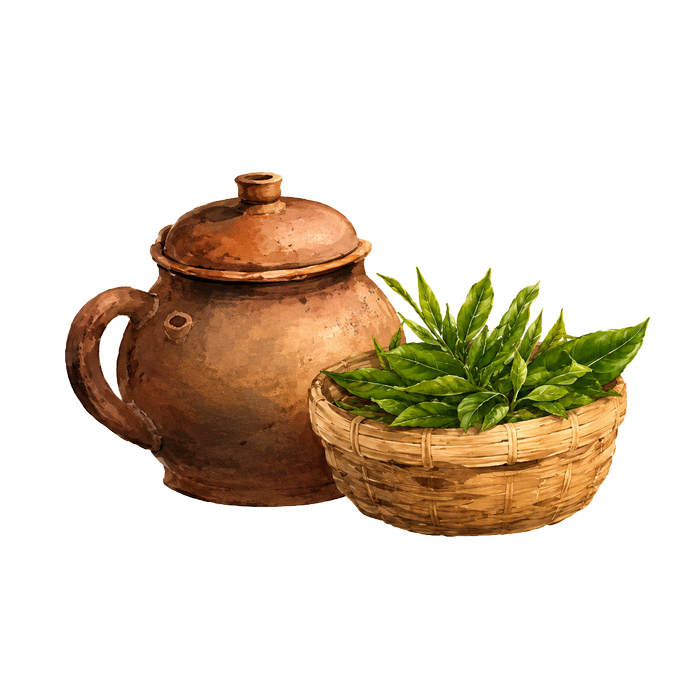
Ancestral Origins

From the legend of Emperor Shennong to the first crops in the mountains of Yunnan: the birth of a millennial tradition.

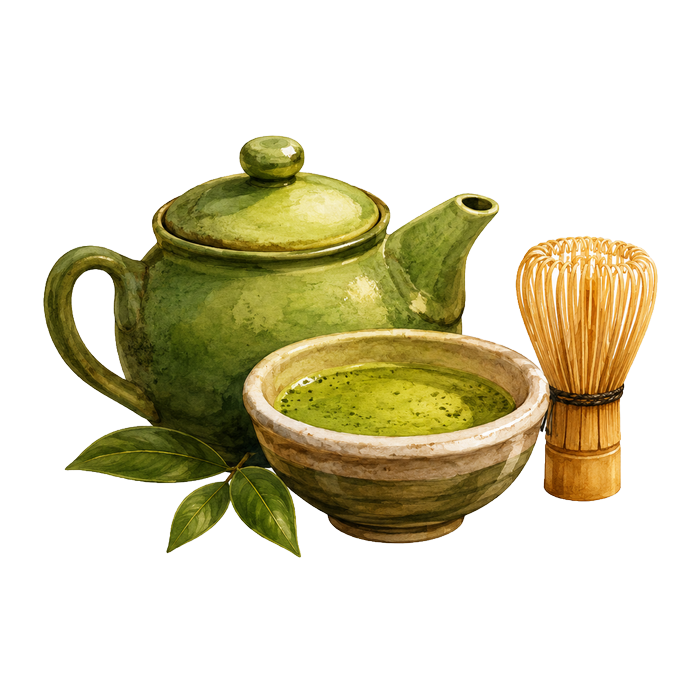
The Way of Tea

The matcha revolution in Song China and the birth of Japanese Chado: when drinking tea became an art and a philosophy of life.

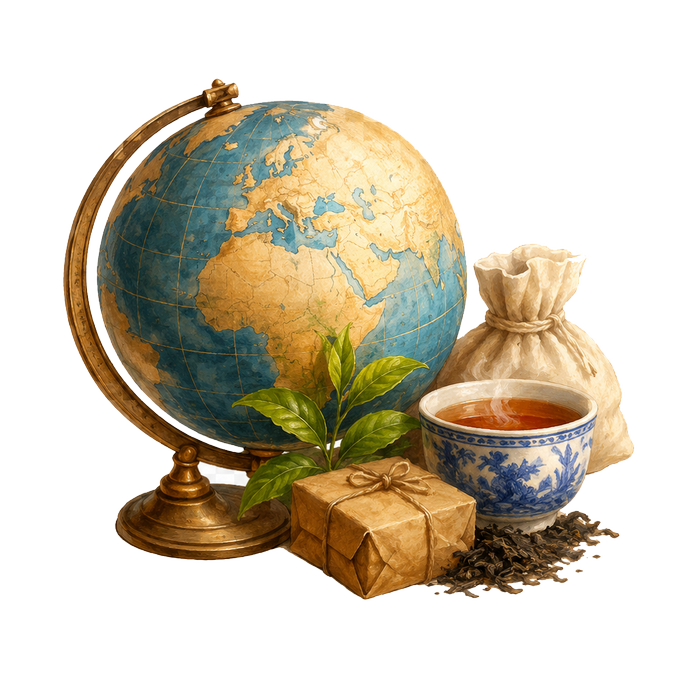
Routes and Empires

The Silk Road and the great wars for its control: how a simple leaf became the engine of world trade.

Europe and Globalisation

From European aristocratic obsession to the 20th century tea bag: the democratisation of a luxury that conquered the world.

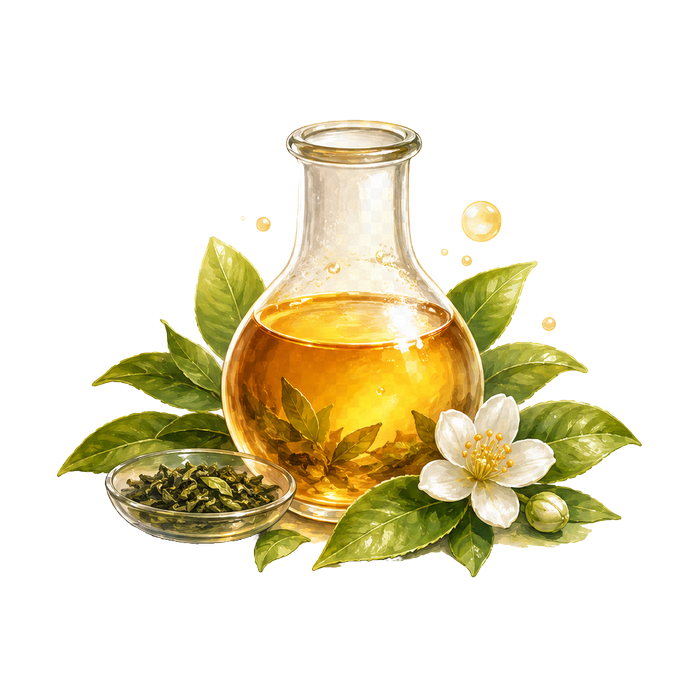
Science and Wellbeing

Polyphenols, L-theanine and mindfulness: modern science rediscovers what the East has practised for centuries.

Tea Today: Spain

Andalusian heritage and a contemporary renaissance: the place of tea in the Spanish cup of today and tomorrow.
There is a drink that needs no introduction. It is in the dawn of ancient China, in the silent ceremonies of feudal Japan, in the salons of Victorian England, in the fragrant souks of Marrakech and in the cup you are holding at this very moment. Tea is not simply an infusion: it is one of the longest and most compelling stories in human history.
With more than 5,000 years of documented history, tea (Camellia sinensis) is today the most consumed drink on the planet after water. More than 3 billion cups are prepared every day across the five continents. Wars, empires, entire philosophies, trade routes thousands of kilometres long and sacred rituals have revolved around this humble-origin plant. To know its history is, in a way, to know the history of the human being.

5,000

YEARS OF HISTORY
From the first records in China

3 billion

CUPS PER DAY
Only surpassed by water

+60

PRODUCING COUNTRIES
From China to Kenya, from India to the Azores

300 M

TONNES/YEAR
Estimated world production (2024)
· 2737 BC — ANCIENT CHINA ·

The Gift of Heaven: The Legendary Origins

The official history of tea begins with a legend. Emperor Shennong, known as the "Divine Farmer", wisely governed ancient China. Obsessed with the health of his subjects, he decreed that all water for consumption must first be boiled.
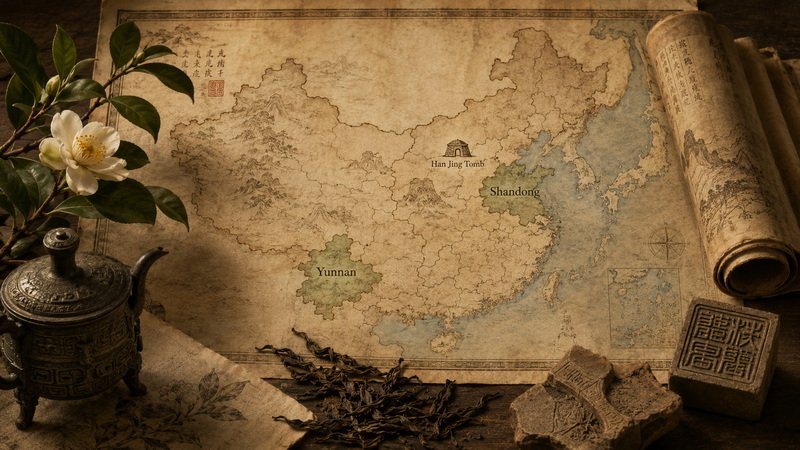
Beyond the myth, archaeology offers us fascinating evidence. In 2016, researchers at Shandong University of Science identified remains of Camellia sinensis in the tomb of Emperor Han Jing, dated to the 2nd century BCE — the oldest tea sample ever found. Yet it is in Yunnan province, in south-western China, where the oldest tea trees on earth are found: wild specimens over 3,000 years old, known as gushu or "ancient trees", whose leaves are today the most coveted on the international market.
Before the spring rain, the flavour of young leaves touches the palate as the first morning sun touches the river.
— Proverb of the Yunnan farmers
During the Shang and Zhou Dynasties (1600–256 BCE), tea was essentially a medicinal plant. The writings of physician Hua Tuo mention the leaves of ku tu — "bitter tea" — as a remedy for fatigue, mental confusion and digestive ailments. They were also consumed as a chewed paste mixed with ginger and salt, far removed from the ritual we know today.
· 3RD — 10TH CENTURY AD ·

The Golden Age: Lu Yu and the Culture of Tea

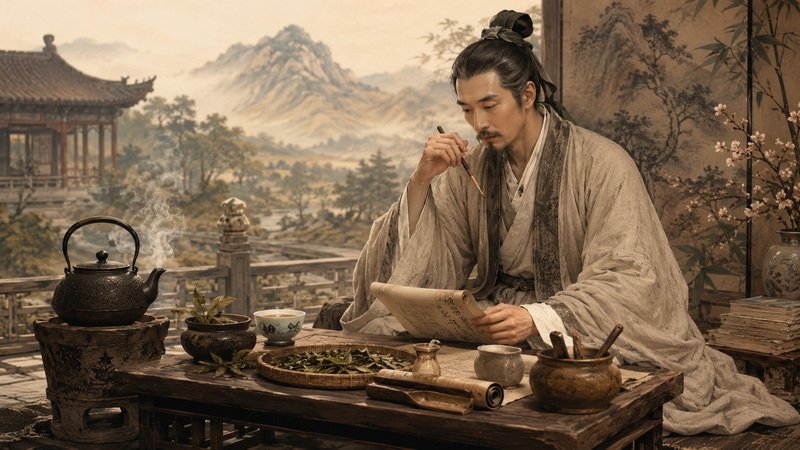
If there is one moment when tea ceased to be a mere remedy and became an art of living, that moment is the Tang Dynasty (618–907 CE). It was in this golden age of culture that the Buddhist monk and poet Lu Yu wrote the Cha Jing (茶經), the Classic of Tea, the first monographic work on tea in the history of humanity.
Published around 780 AD, the Cha Jing is an extraordinary text. In its ten chapters, Lu Yu elaborated an entire philosophy of life based on contemplation, mindfulness and harmony with nature. He detailed the different types of soil, the correct way to harvest, the appropriate utensils — describing up to 24 specific instruments for preparation — and the ideal water sources: preferably mountain spring, then river, and only when necessary, well water.
During the Tang Dynasty, tea also became China's first export currency: the so-called "tea bricks" (bing cha) served as currency along the Silk Road, exchanged for horses in Mongolia, spices in Persia and cloth in Central Asia. Tea was, quite literally, money.
— Proverb of the Yunnan farmers
· 10TH — 14TH CENTURY AD ·

The Matcha Revolution: The Song Dynasty

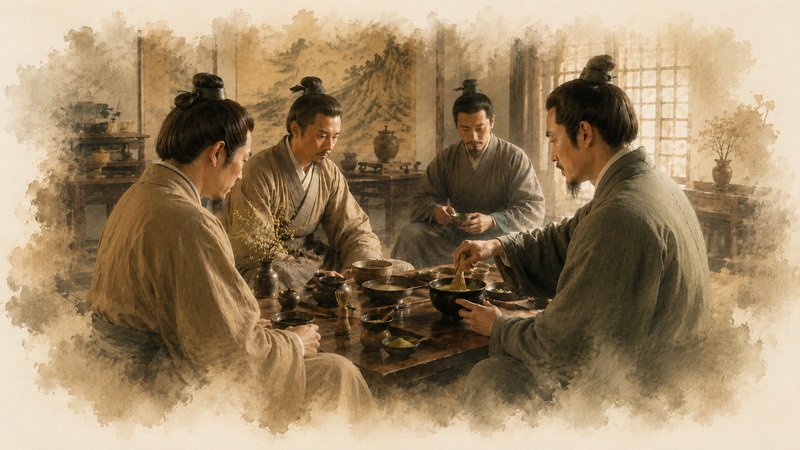
With the arrival of the Song Dynasty (960–1279 CE) came a silent revolution. Song masters abandoned the pressed Tang cake and began steaming and grinding the leaves into the finest green powder: thus was born the technique that centuries later we would call matcha. This powder was vigorously whisked with hot water using a bamboo whisk — the exact forerunner of the Japanese chasen — until it created a delicate, velvety foam.
The Song court took tea culture to unimaginable heights of refinement. Emperor Huizong — an extraordinary artist and, unfortunately for his subjects, a mediocre statesman — dedicated an entire treatise to the art of whisking tea. Tea houses (cha guan) proliferated in the cities, the first "cafés" of history. Tea competitions (dou cha) were even organised, where participants had to prepare the cup with the whitest, densest and longest-lasting foam.
· 1191 AD — JAPAN ·

Japan and Chado: The Way of Tea

In 1191, the Zen Buddhist monk Eisai Myōan returned from China to Japan carrying Camellia sinensis seeds and the Song powdered tea technique. He planted the first seeds on Mount Sefuri and published the Kissa Yōjōki — "Drinking Tea for Health" — the first treatise on tea in the Japanese language.
But it was master Sen no Rikyū (1522–1591) who transformed Japan's relationship with tea forever. Rikyū developed the concept of wabi-cha — "the tea of poetic simplicity" — and codified the ritual we know today as Chado or Chanoyu (茶道), literally "the Way of Tea". In opposition to the ostentatious luxury of aristocratic ceremonies, Rikyū championed a radical aesthetic of austerity, imperfection and presence: rough ceramic vessels, tiny tea huts, wild flowers. His philosophy rests on four eternal principles:
Tragically, Rikyū himself was ordered by his patron, the warlord Toyotomi Hideyoshi, to commit seppuku in 1591. His legacy endures, however: his descendants founded the three most important tea schools in Japan — Ura Senke, Omote Senke and Mushanokōji Senke — which continue to teach Chado throughout the world.

Wa — Harmony
Harmony with the environment, people and the present moment

Kei — Respect
Deep respect towards the guest, the host and the utensils

Sei — Purity
Purity of body, mind and the sacred space of tea

Jaku — Stillness
Stillness and peace as the destination of the inner path
· 7TH — 18TH CENTURY ·

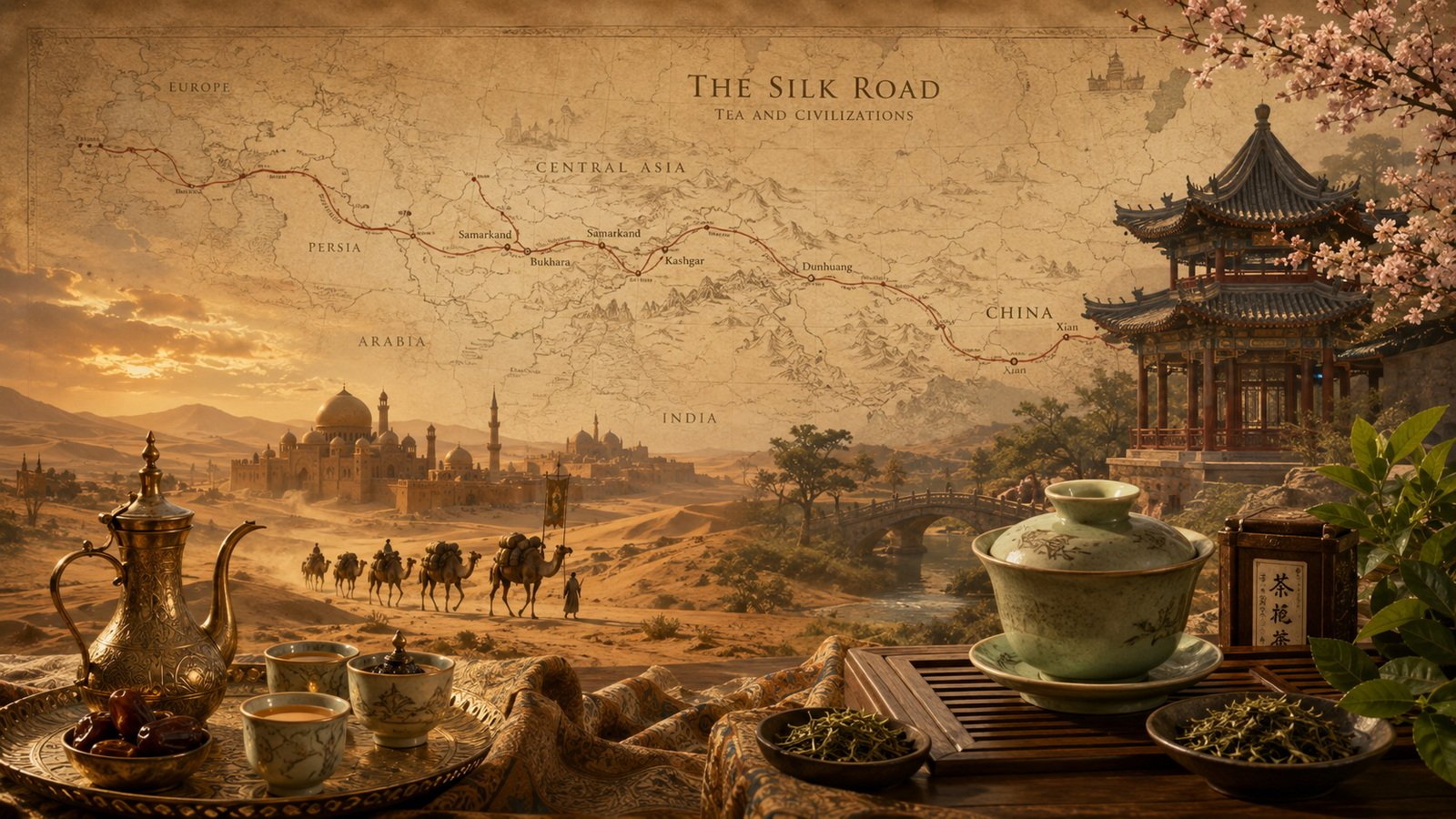
The Silk Road: Tea Conquers the World

While China and Japan were perfecting their rituals, tea began its silent conquest of the planet. The caravans travelling the Silk Road carried pressed tea bricks to the heart of Central Asia, and each culture adapted that green leaf to its own identity.
In Tibet, tea was mixed with yak butter and salt to create po cha, a calorie-rich drink essential for surviving the Himalayas. In Mongolia, the warriors of Genghis Khan drank black tea boiled with mare's milk. In Persia and the Arab world, strong black tea sweetened with sugar cane became a symbol of hospitality. It was in the era of the Ottoman Empire that çay (Turkish tea) emerged, served in its characteristic tulip-shaped glass vessels.
The first glass is as gentle as life, the second as strong as love, the third as bitter as death.
— Berber proverb about Moroccan mint tea (atay)
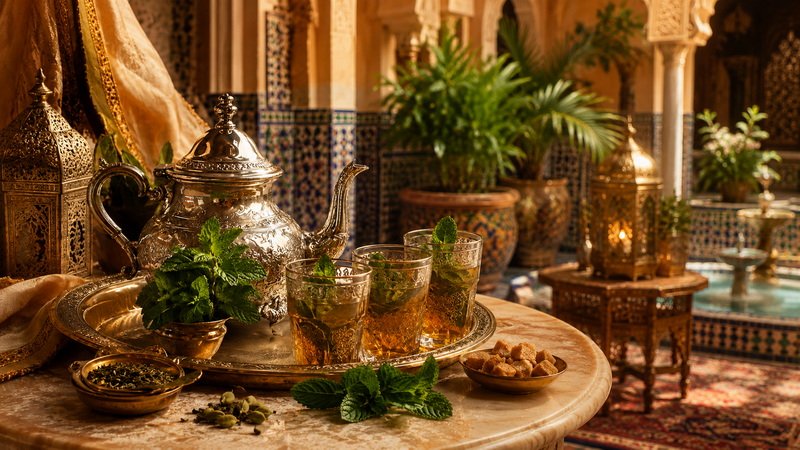
The Maghreb case deserves special attention. Mint green tea reached North Africa through Ottoman traders and Mediterranean ports. The Berbers adopted and transformed it: they added fresh spearmint and plentiful sugar, developing the ritual of Moroccan atay, which today defines the cultural identity of the Maghreb. Served from a great height to aerate it and create foam, refusing it is considered a serious discourtesy.
· 16TH — 18TH CENTURY ·

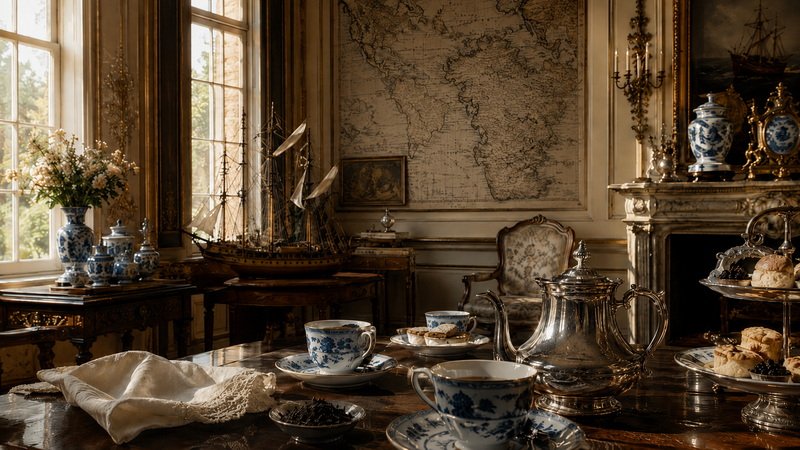
Europe Discovers Tea: Obsession and Elegance

The Western world was slow to discover tea, but when it did, it did so with the same intensity with which it had fallen in love with silk and spices. The first Europeans to import it were the Portuguese, who encountered it in Macau around 1557. However, it was the Dutch East India Company (VOC) that, in 1610, established the first regular tea trade between China and Europe, turning Amsterdam into the first Western tea hub.
The great revolution came to England in 1662, when Catherine of Braganza, a Portuguese princess and new queen consort of Charles II, arrived at the court of London with a chest full of tea leaves as part of her dowry. The queen made tea fashionable among the nobility, displacing beer and wine. Within a few decades, London's tea houses had multiplied: by 1700 there were more than 2,000 in the city.
The Duchess of Bedford, Anna Maria Stanhope, is credited with the invention of afternoon tea around 1840. She suffered from a "sinking feeling" in the mid-afternoon — the gap between the early lunch and the late Victorian dinner — and began inviting friends for tea with sandwiches and pastries. The fashion spread throughout the aristocracy and "five o'clock tea" became a social institution that remains one of the most recognisable rituals in the world today.
The great types of tea that Europe spread to the world
🍵

Green Tea

China · Japan
🫖

Black Tea

India · Sri Lanka
☁️

White Tea

Fujian · China
🌿

Oolong

Taiwan · Fujian
🟢

Matcha

Uji · Japan
🍂

Pu-erh

Yunnan · China

Bring the world of tea to your cup

Thousands of years of history, distilled into signature blends created with the finest origins in the world. Artisanal, functional, authentic.
· 18TH — 19TH CENTURY ·

Wars, Empires and The Great Tea Heist

The British obsession with tea had major geopolitical consequences. In the early 19th century, Britain's trade deficit with China was alarming: the English were buying vast quantities of tea, silk and porcelain, but the Chinese wanted nothing that the British produced. The solution found by the British East India Company was as brilliant as it was criminal: it began massively exporting opium from India to China, creating an epidemic of addiction that devastated millions of people.
When Emperor Daoguang banned opium and destroyed 1,400 confiscated tonnes, Britain responded with the First Opium War (1839–1842), forcing China to open its ports and cede Hong Kong. Tea, which had begun as a gift from heaven, became the trigger for one of the most shameful wars in imperial history.
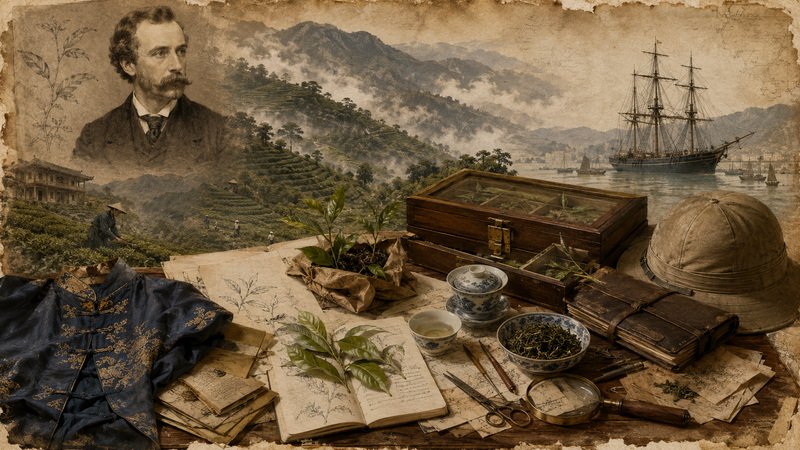
The true "theft of tea" was the work of one man. In 1848, Scottish botanist Robert Fortune was sent to China disguised as a local mandarin to steal the secrets of cultivation. He spent months in Fujian and Zhejiang, learned the manufacturing process and clandestinely extracted thousands of plants, seeds and tea masters. Thanks to this industrial espionage, cultivation was transplanted to India, breaking China's monopoly forever.
1823Scottish major Robert Bruce discovers wild tea plants in Assam. Indian tea is born.
1840First commercial plantations in Darjeeling, at the foothills of the Himalayas. The "champagne of teas" is born there.
1867Ceylon (now Sri Lanka) converts its coffee plantations devastated by blight into vast tea gardens. The famous "Ceylon Tea" is born.
1903Experimental crops in East Africa. Kenya would become the world's largest exporter of black tea.
· 20TH CENTURY ·

From Empire to Tea Bag: The Democratisation of Tea

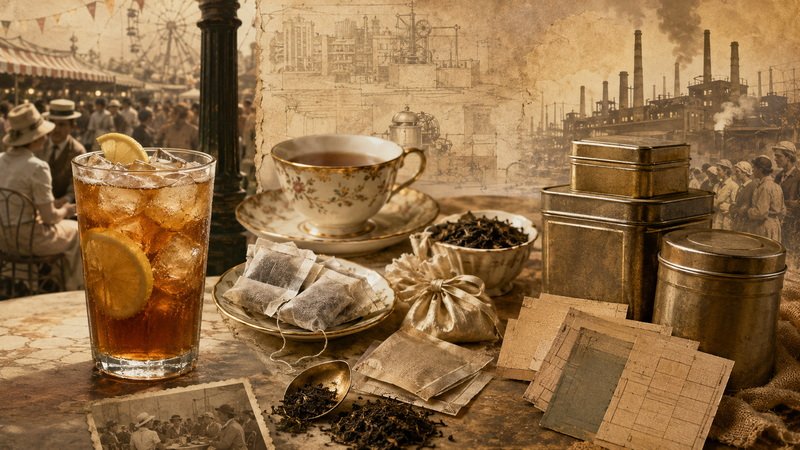
The 20th century brought two inventions that would forever change how the world drinks tea. In 1904, New York merchant Richard Blechynden, at the height of the St. Louis World's Fair, decided to pour the hot tea he could not sell over ice cubes. Thus was born iced tea, today one of the most popular drinks in North America.
That same year, importer Thomas Sullivan of New York began sending tea samples in small silk pouches. His customers submerged them directly in water without opening them. The result was so practical that Sullivan was inundated with orders. His silk pouches would become the future tea bags — the format that today represents 60% of global consumption.
During World War II, the British government temporarily nationalised the tea trade, considering it as essential as coal or ammunition. Churchill stated that tea was "more important than any other food". Tea rations became currency in prisoner-of-war camps and among soldiers on every European front.
The second half of the 20th century brought industrial mass production. Large companies such as Lipton, Tetley and Twinings popularised tea bags on a global scale, at the cost of sacrificing quality: low-cost blends mix hundreds of different origins to guarantee uniformity. Tea, which in its origins was an expression of the terroir, the season and the master who crafted it, became an anonymous commodity.
· 21ST CENTURY ·

The Tea Renaissance: Science, Consciousness and Soul

Over the past two decades, the world of tea has undergone a quiet but profound revolution. Just as the artisan coffee of the third wave rescued espresso from industrialisation, the specialty tea movement has reclaimed for this drink all its complexity, its narrative and its ancestral dignity.
Today, tea sommeliers guide discerning consumers in the discovery of single origin or gushu teas. A quality aged Pu-erh can reach Grand Cru wine prices. An authentic ceremonial matcha from Uji, Japan, costs more per gram than many luxury perfumes.
Modern science has come to confirm what Chinese physicians knew millennia ago. The polyphenols and catechins in green tea — especially EGCG (epigallocatechin gallate) — have demonstrated antioxidant and anti-inflammatory properties. L-theanine, an amino acid unique to tea, produces a state of "serene alertness" by interacting with caffeine, generating focus without the nervous peaks of coffee.

L-tean.

EXCLUSIVE AMINO ACID
Serene alertness without nervousness. Only in Camellia sinensis

EGCG

POWERFUL ANTIOXIDANT
Cardiovascular protection and anti-inflammatory effect

137×

MORE ANTIOXIDANTS
Matcha concentrates 137 times more than standard green tea

Adapto.

NEW FRONTIER
Ashwagandha, rhodiola and ginseng enhance functional tea
The phenomenon of functional tea is perhaps the most modern expression of ancestral wisdom: blends that combine Camellia sinensis with adaptogens, medicinal plants and mushrooms such as reishi and chaga, to offer specific and measurable benefits: deep sleep, clean energy, optimised digestion, reinforced immunity.
· THE PRESENT AND THE FUTURE ·

Spain and Tea: Andalusian Heritage and Renaissance

There is a historical connection between the Iberian Peninsula and tea culture that is rarely told. During the eight centuries of Islamic presence in Al-Andalus (711–1492), the Arabs and Berbers who inhabited Granada, Seville, Córdoba and Valencia brought with them their own tea traditions. The Andalusian zocos traded in spices, herbs and aromatic plants from all over the known world; the hammam offered healing infusions. Spain was for centuries the meeting point between the European herbal tradition and the Arab-Mediterranean tea culture.
Today, that legacy is reviving with renewed vigour. Spanish tea culture has grown steadily over the last decade: artisan tearooms proliferate in Madrid, Barcelona, Granada and Seville; the premium tea and herbal market is growing at a rate of 8–12% per year; and a new generation of entrepreneurs looks to the world's great gardens to bring their compatriots the best possible quality, with sustainable awareness and cultural narrative.
Tea has no homeland. It was born in China, matured in Japan, conquered England, became intoxicated with mint in Morocco and today flourishes in Andalusia with the same spirit of one who always sought the authentic.
In this context of renaissance, Almaté was born, a brand born in the heart of Spain with a clear vision: to build a bridge between the millennial wisdom of tea and the modern wellbeing of Spanish and Latin American consumers. Its signature blends, created with deep knowledge of the functional properties of each plant, honour the tradition of the world's great gardens while responding to today's needs for balance, energy, rest and inner connection.
Almaté understands tea not only as a drink, but as a daily ritual of presence and care. Each cup brings together origin, science, sensitivity and soul: ingredients selected with discernment, combinations designed for real wellbeing and an aesthetic that celebrates the beauty of the natural. From Spain and its Andalusian richness, Almaté proposes a new way of living tea: close, conscious, elegant and profoundly human.

· FINAL REFLECTION ·

Every Sip, Five Thousand Years of Humanity

The history of tea is, ultimately, a story about the human search for wellbeing, beauty and connection. From the hands of Emperor Shennong to yours, more than a hundred generations have passed, dozens of cultures and endless transformations. And yet the essential gesture remains identical: someone who stops, picks a leaf of Camellia sinensis, immerses it in hot water and waits, in silence, for the world to become a little kinder.
What has changed — and for the better — is the knowledge surrounding that gesture. Today we know which active compounds each variety contains, how they act on our biochemistry, what temperature releases the best aromas without making the tannins bitter, which adaptogens enhance their effects. Tradition and science are finally speaking the same language.
Welcome to the way of tea.
It began five thousand years ago. In your cup, it always begins now.

Write your own story with tea

Discover Almaté's blends: crafted with the finest origins in the world, designed for your wellbeing and delivered with the soul of five thousand years of tradition.

References and Sources

  1. Lu Yu (780 CE). Cha Jing (The Classic of Tea). Beijing: China Arts and Crafts Publishing House, 2003.
  2. Hohenegger, B. (2007). Liquid Jade: The Story of Tea from East to West. St. Martin's Press, New York.
  3. Fortune, R. (1852). A Journey to the Tea Countries of China. John Murray, London.
  4. Pettigrew, J. & Richardson, B. (2014). A Social History of Tea. Benjamin Press.
  5. Okakura, K. (1906). The Book of Tea. Trans. Miraguano Ediciones, 2012.
  6. Heiss, M.L. & Heiss, R.J. (2007). The Story of Tea: A Cultural History and Drinking Guide. Ten Speed Press.
  7. Zhang, L. et al. (2016). "Earliest tea as evidence for one branch of the Silk Road". Scientific Reports, 6, 18955. doi:10.1038/srep18955
  8. Weiss, D.J. & Anderton, C.R. (2003). "Determination of catechins in matcha". Journal of Chromatography, 1011(1–2), 173–180.
  9. Nathan, P.J. et al. (2006). "The neuropharmacology of L-theanine". Journal of Herbal Pharmacotherapy, 6(2), 21–30.
  10. FAO (2023). Tea Market Review. Food and Agriculture Organization of the United Nations. Rome.

Your First Ritual Awaits

Exclusive discounts and new rituals every week

We care about your privacy. By subscribing, you agree to receive emails from Almaté and our privacy policy. You can unsubscribe at any time.

  • es
  • en
  • fr